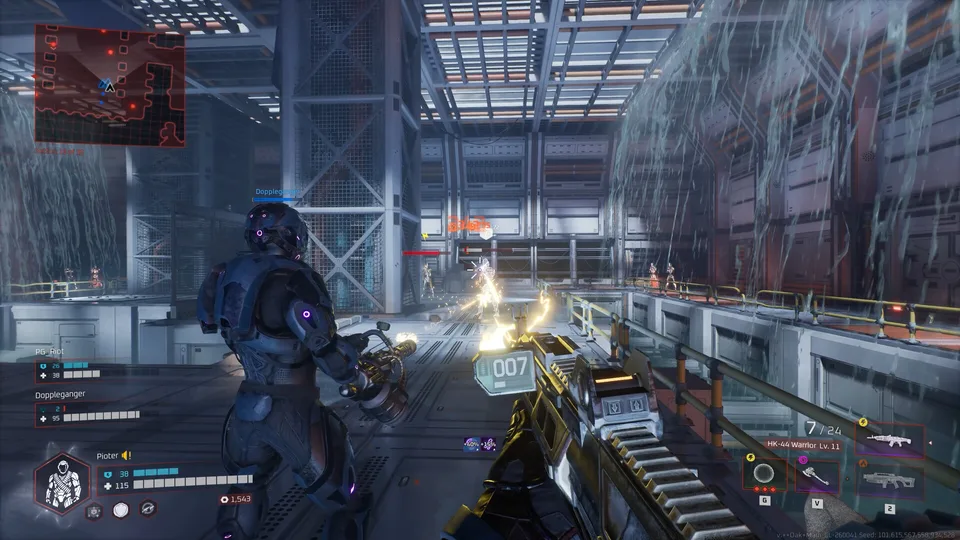
Deadzone Rogue 2 Build Guide: Weapons, Augments, and Strategy
Master your loadout in Deadzone Rogue 2. Learn how to combine weapons, augments, and elements to create powerful builds for solo or co-op runs.
Published: Deadzone Rogue 2 Wiki Editorial Team
Table of Contents
Mastering Your Build in Deadzone Rogue 2
In Deadzone Rogue 2, your survival in the fallen Earth environment hinges on your ability to adapt your loadout on the fly. As a roguelite, the game emphasizes the synergy between your primary equipment and the modifiers you pick up during a run. Whether you are looking for specific projectile mechanics—often described by players as distinct weapon behaviors like "frisbees" or bouncing energy discs—or trying to optimize your damage output, understanding the building blocks of your loadout is essential.
Because the game is still evolving, your ability to experiment with different combinations is your greatest asset. The current demo, available on PC, PS5, and Xbox, provides a stable environment to test these systems. While progression does not carry over to the full release, the time you spend learning how different augments interact with your weapons will translate directly to your performance in the full game.
The Mechanics of Power: Weapons, Augments, and Elements
Building a powerful character in Deadzone Rogue 2 is not about finding a single "best" item; it is about creating a cohesive system where your weapons, augments, and elements amplify each other.
Weapons
These are your primary tools for clearing waves of machines. Each weapon has a base behavior, such as fire rate, magazine size, and projectile type.
Augments
These are modifiers that change how your weapon behaves. They can add status effects, change projectile physics (like bounce or spread), or increase damage based on specific conditions.
Elements
Elemental damage types (like fire, electric, or others) define your primary source of damage-over-time or crowd control. Combining these with the right augments is key to high-level play.
To build effectively, you must prioritize synergy. For example, if you are using a weapon that fires high-velocity projectiles, look for augments that add piercing or ricochet effects. This turns a standard weapon into a room-clearing tool. Community feedback from the recent playtests suggests that players who focus on one specific damage type often find more success than those who spread their resources too thin across multiple, conflicting elements.
Optimizing Projectile Weapons and Build Synergy
Players often search for specific weapon behaviors, such as projectiles that bounce or act like "frisbees" to clear corners and tight spaces. In Deadzone Rogue 2, the game's engine allows for varied projectile physics. If you are looking for a "frisbee-like" playstyle, focus your search on weapons with high ricochet stats or augments that modify projectile trajectory.
Identify the Base Behavior: Choose a weapon that already has a wide spread or unique firing pattern.
Apply Augments: Look for augments that grant "Bounce" or "Chain" effects. These are essential for creating the projectile-heavy builds that function similarly to disk-throwers.
Select Elemental Perks: Pair your bouncing projectiles with elemental effects like "Shock" or "Freeze" to crowd-control enemies as your projectiles traverse the map.
Test in the Demo: Use the free demo to experiment with these combinations. Since progression doesn't carry over, there is no penalty for "wasting" resources on a build that doesn't work.
If you find that a build feels "off," it is often because the base weapon's fire rate doesn't support the augment's effect. For instance, a slow-firing weapon with a "multi-shot" augment might feel sluggish, whereas a high-fire-rate weapon with the same augment becomes a chaotic storm of projectiles.
Solo vs. Squad Tactics
Deadzone Rogue 2 is designed to be played solo or with friends. Depending on your team size, your build priority should shift.
In solo runs, you must be a generalist. You need high burst damage for bosses and consistent area-of-effect (AOE) damage for waves of machines. You cannot rely on teammates to cover your weaknesses, so ensure your build includes some form of survivability, such as life-steal or shield-regeneration augments.
In co-op, you can afford to specialize. One player might focus on heavy, single-target damage to take down elite machines, while another focuses on crowd control—using those "frisbee" or ricochet-style builds to keep smaller enemies at bay. The drop-in co-op and server browser make it easy to coordinate these roles even with random players.
Tip
Communication is Key: Even with a server browser, use the ping system or voice chat to coordinate your builds. If your squadmate is already running a fire-based build, consider picking up a cold or electric element to maximize your team's total elemental coverage.
Learning from the Playtest: Community Feedback
The development team at Prophecy Games has been highly active in gathering feedback. With over 75,000 players participating in the August playtest, the community has provided significant insights into what makes a build feel satisfying.
Community reports often highlight the following common pitfalls when creating builds:
Redundant Stats: Players have noted that splitting "+Gun Damage" and "+Weapon Damage" can lead to confusion. When building your loadout, try to focus on one or the other to avoid "diminishing returns" or wasted item slots.
Shop Management: In the demo, you cannot reroll shop items. This means you must be decisive with your credits. Don't save credits hoping for a specific item if your current build is struggling—invest in what is available to stay ahead of the difficulty curve.
Performance: Some players reported that certain high-particle-effect builds can cause frame rate drops. If you are aiming for a screen-filling projectile build, keep an eye on your performance settings.
FAQ
Can I carry over my demo progression to the full game?
No. The developers have confirmed that progression will not carry over. This is to ensure that players are testing the game systems fairly and to allow the team to make balance adjustments without worrying about legacy save data.
Is the demo the same as the full game?
The demo is a polished slice of the experience. It feels similar in terms of core gameplay and content to what you can expect in the full version, but it is specifically intended for testing and feedback.
How do I play with friends?
The game supports co-op for up to 3 players. You can use the server browser to find games or invite friends directly. Drop-in co-op is also supported, allowing you to join runs that are already in progress.
Will there be updates to the demo?
As of the latest updates from the Prophecy Team, they do not expect to update the demo for the time being. They are focused on the full game development based on the feedback gathered.